What Makes a Main Course Healthy?
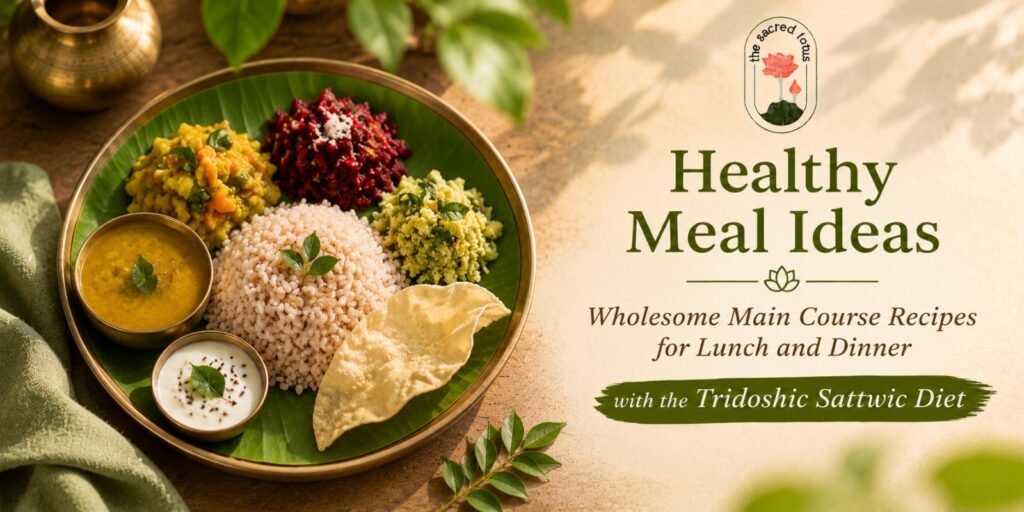
So what counts as healthy? Honestly, it’s the meal that doesn’t send you looking for a pillow at 3 pm. Some grain, some dal or cherupayar or kadala, two vegetables, and only as much oil as the tempering needs.
Our grandmothers never called it “balanced.” Rice, sambar, a cabbage thoran, and a glass of moru were just Tuesday. The cooks at The Sacred Lotus make the same food, only with a lighter hand on the oil and salt and a heavier one on ginger, pepper, and jeera.
Keep reading for three healthy main course recipes, a few nutrient-rich breakfasts to start the day right, and some balanced meal ideas that work on a normal weekday.
Healthy Indian Main Course Recipes for Everyday Meals
Which Indian dishes are the best picks? Anything steamed, simmered, or quickly tossed in a pan, with pulses and vegetables doing most of the work. Sambar, dal, avial, thoran, stew, and cherupayar curry all qualify. These three healthy main course recipes are easy enough to cook on rotation.
Recipe 1: Kerala Vegetable Stew with Red Rice
Serves 3 · 30 minutes
- 2 cups mixed vegetables (carrot, beans, potato, peas)
- 1 cup thin and ½ cup thick coconut milk
- 1 onion, 2 green chillies, 1-inch ginger, curry leaves
- 1 tsp coconut oil, 2 cloves, a small piece of cinnamon, salt
Let the cloves and cinnamon sizzle in the oil for a few seconds. Throw in the onion, chillies and ginger, and wait till the onion goes soft. In go the vegetables and the thin coconut milk; lid on, low flame, until everything is tender. Pour in the thick milk with the curry leaves and switch off the stove before it bubbles, or it’ll split. Red rice on the side. See our kitchen’s version: Kerala Veg Stew.
Recipe 2: Cherupayar (Green Gram) Curry
Serves 3 · 25 minutes, plus overnight soaking
- 1 cup cherupayar, soaked overnight
- ¼ cup grated coconut, ½ tsp jeera, 2 shallots
- ¼ tsp turmeric, salt, 1 tsp coconut oil, mustard seeds, and curry leaves
Cooker, turmeric, salt, 3–4 whistles. While it cools, grind the coconut with the jeera and one shallot. Mix that in. Splutter mustard, curry leaves, and the other shallot in oil and tip it over the top. Eat it with rice, chapati, or our favorite, puttu.
Recipe 3: Avial
Serves 4 · 30 minutes
- 3 cups vegetables cut into batons (drumstick, raw banana, carrot, ash gourd, beans)
- ½ cup grated coconut, 2 green chillies, ½ tsp jeera
- ½ cup thick curd, 1 tsp coconut oil, curry leaves, turmeric, salt
Cook the vegetables with turmeric, salt, and very little water. They should still hold their shape. Crush the coconut, chillies, and jeera roughly (don’t make a smooth paste) and fold it through. Off the heat, stir in the curd, then drizzle raw coconut oil and scatter curry leaves on top. That last spoonful of oil is what makes it smell like a proper avial. Full recipe: Avial.
There are plenty more recipes like these in our hearty main courses collection, including the one-pot Vegetable Pulav and Palak Khichdi.
Nutrient-Rich Healthy Breakfast Recipes
What makes a breakfast nutrient-rich? A whole grain or millet, something fermented or steamed, and a curry or chutney with vegetables or pulses on the side. Here are four from our kitchen that pair well with the healthy main course recipes above.
Oats Carrot Puttu
Kerala’s breakfast classic with a fiber-rich twist. Roasted, coarsely ground oats are mixed with grated carrot, layered with fresh coconut, and steamed for 10 minutes. Have it with kadala curry or a ripe banana. Recipe: Oats Carrot Puttu.
Millet Dosa
Ragi and urad dal are soaked, ground, and fermented overnight, then spread thinly on a hot pan. It’s crisp like a regular dosa, with more fiber. Serve with coconut chutney. Recipe: Millet Dosa.
Veg Rava Idli
The quickest of the lot, with no overnight soaking. Roasted rava, curd, grated carrot, and coriander rest for 20 minutes, then steam in idli molds. Recipe: Veg Rava Idli.
Appam with Vegetable Stew
Lacy at the edges, soft in the middle. Appam’s fermented rice batter goes perfectly with the vegetable stew from Recipe 1. Recipe: Appam.
For more morning ideas, browse our healthy breakfast delights.
Nourishing Meals with Vegetables, Grains, and Lentils
Why put rice and dal together? Because each fills in the other’s gaps. Cereals and pulses carry different amino acids, so together they give a vegetarian plate better-quality protein. Rice and sambar, puttu and kadala, dal and chapati: these are the classic combinations behind most wholesome Indian meals. The ICMR–NIN also suggests that at least half your cereals should be whole grains, millets included.
| Grain | Pulse | Vegetables | You’d know it as |
|---|---|---|---|
| Red rice | Toor dal | Drumstick, pumpkin, okra | Rice and sambar |
| Puttu (rice or ragi) | Black chickpeas (kadala) | Onion, tomato | Puttu–kadala |
| Broken wheat or millet | Moong dal | Carrot, beans, peas | Vegetable khichdi |
| Chapati | Cherupayar | Cabbage, carrot | Chapati, cherupayar curry, thoran |
Any one of these makes a wholesome Indian meal on its own, and the whole lot costs less than a takeaway.
How to Build a Balanced and Nutritious Plate
What should your plate look like? Going by the ICMR–NIN’s My Plate for the Day, vegetables, fruit, and leafy greens make up about half of a day’s food. Cereals and millets take most of what’s left, then pulses, then milk or curd.
A few balanced meal ideas to make that real:
- Pile on the vegetables first. Half the plate, and try to sneak in a leafy green: chera, muringa leaves, or whatever’s fresh.
- Go easy on the rice. About a quarter of the plate. Red rice, or millets, beats polished rice and maida.
- Give the last quarter to Dal, Sambar, Cherupayar, or Kadala, whichever you like.
- Add curd or moru. It brings calcium and a little protein.
- Actually measure the oil. Coconut oil and ghee are part of our cooking, but a teaspoon usually does the job.
Make lunch the biggest meal. Most healthy lunch recipes from a Kerala kitchen follow this plate exactly. For nutritious dinner recipes, keep it smaller and earlier: khichdi, kanji with cherupayar, or stew with one chapati. Not that hungry at night? Our juices and soups are a good stand-in, and something from our salads and starters works on the side. For something sweet after lunch, our delectable desserts lean on jaggery and fruit rather than white sugar. Small bowl, now and then.
Frequently Asked Questions
Rice or millet, a dal, and two vegetables, like red rice with sambar and thoran. Nearly every one of the healthy lunch recipes we grew up with follows that pattern, and it covers protein, fiber, and slow energy in one go.
Moong dal khichdi, kanji with cherupayar, or stew with a single chapati. These nutritious dinner recipes are warm, simple, and easy on the stomach.
Steamed or fermented dishes made with whole grains or millets, such as oats carrot puttu, millet dosa, or rava idli, served with a curry or sambar.
Mostly, yes. Sambar, avial, thoran, and stew are all. Just keep an eye on how much coconut oil goes in and on the pappadam count.
Usually, if grains and pulses go together, there’s curd on the table. If you have specific protein needs, check with a doctor or dietitian.
Conclusion: Simple, Balanced Meals Every Day
None of these healthy main course recipes need anything special. Red rice, a pot of dal, seasonal vegetables, and a few spices are enough. Pick one of these healthy main course recipes this week and see how your afternoons feel.
And if you’d like to eat this way for a while, with authentic Ayurvedic care alongside, come and stay at our Ayurveda retreat in Kerala, tucked into the old streets of Fort Kochi.